

Sensor types. Mast elevation. Payload tiers. How to get a counter-drone detection system from the shipping crate to operational in the field.
Why Counter-Drone Detection Matters for Law Enforcement
Drones are not a future problem. They are a current one.
Criminal organizations use commercial drones to conduct surveillance on police operations, gathering intelligence on officer positions, entry points, and tactical formations in real time. Correctional facilities across the country deal with drone-delivered contraband on a near-daily basis. Public events from concerts to political rallies face the growing threat of unauthorized drones entering restricted airspace, whether carrying cameras, payloads, or simply creating panic.
The federal response is accelerating. The Department of Homeland Security has expanded its counter-UAS program, and the Pentagon recently launched an online portal for counter-drone equipment procurement. The FAA’s Public Safety Toolkit now includes specific guidance for agencies encountering unauthorized drone activity. These are not theoretical frameworks. They exist because the threat volume demanded them.
For most state and local agencies, the capability gap is not awareness. Commanders know drones are a problem. The gap is implementation. How do you actually stand up a detection capability that works at a stadium on Saturday and a critical infrastructure site on Monday? That is what this guide covers.
How Drone Detection Systems Work
There is no single sensor that does everything. Every counter-drone detection system relies on one or more of four core technologies, each with distinct strengths and limitations. Understanding what each sensor actually does is the first step toward building a system that works in the field.
Radio Frequency (RF) Detection
RF sensors intercept the radio communication between a drone and its controller. They can identify the drone’s make and model based on its signal signature, and in many cases locate both the drone and the pilot. Companies like DeDrone and D-Fend Solutions build RF detection platforms specifically designed for law enforcement deployments. RF detection is fast, proven, and effective against the vast majority of commercial drones on the market today.
The limitation: RF sensors only work when the drone is actively communicating with its controller. A fully autonomous drone flying a pre-programmed GPS route with no active RF link is invisible to RF-only detection. These “dark drones” are becoming more common and more accessible. Any detection system that relies solely on RF has a growing blind spot.
Radar
Counter-drone radar detects the physical presence of objects in airspace regardless of whether they are emitting RF signals. This makes radar the primary answer to the dark drone problem. Modern micro-doppler radar systems like Robin Radar’s IRIS can distinguish a drone’s spinning rotors from birds and other airborne objects, significantly reducing false alarms. Radar provides the longest detection range of any sensor type, often reaching several kilometers in open environments.
The tradeoff is that radar alone cannot identify a drone’s make, model, or operator. It tells you something is there and where it is going. It does not tell you who is flying it. That is why radar almost always pairs with RF or optical sensors for positive identification.
Electro-Optical and Infrared (EO/IR)
PTZ cameras and thermal imagers provide visual confirmation and tracking. Once radar or RF detects a target, an EO/IR camera slews to it for positive visual identification. Thermal sensors are particularly effective at night, when a drone’s motors and battery produce a heat signature that stands out against the cooler sky. EO/IR also creates the evidentiary video that law enforcement needs for prosecution.
Cameras are confirmation tools, not primary detectors. They have a narrow field of view relative to radar or RF, and they struggle in fog, heavy rain, and direct sun glare. Use them to verify what other sensors find. Do not rely on them to find the threat in the first place.
Acoustic Detection
Acoustic sensors use microphone arrays to detect the sound of drone propellers. Companies like Squarehead Technology have developed systems that can classify drone types by their acoustic signature alone. Acoustic detection is completely passive, meaning it emits no signal that an adversary could detect. It works against autonomous drones. And it fills coverage gaps in areas outside the line of sight of other sensors.
The range is limited. Most acoustic systems are effective out to 300 to 500 meters at best, and performance degrades in noisy environments like stadiums, highways, or construction sites. Acoustic detection is a gap-filler, not a primary sensor. But in the right deployment, it catches what everything else misses.
Sensor Fusion: The Real Answer
No single sensor covers every scenario. The most effective counter-drone systems fuse two or more sensor types into a single command picture. RF detects the communication link and identifies the drone. Radar tracks the physical target through airspace. EO/IR provides visual confirmation. Acoustic fills the close-in gaps. When one sensor type is degraded by environment or drone configuration, the others compensate. The agencies getting this right are layering sensors, not betting on one technology.
Why Elevation Is the Force Multiplier
Here is the deployment reality most agencies do not talk about. You can buy the best counter-drone sensors in the world and still get poor results if you deploy them at ground level.
A drone detection sensor sitting on a tripod in a parking lot is fighting terrain, structures, vehicles, fencing, tree lines, and every other piece of ground clutter between it and the threat. RF signals bounce off buildings. Radar returns scatter off parked cars. Camera sight lines get blocked by a single delivery truck. The sensor’s published specifications assume clear, unobstructed coverage. Real-world deployment rarely provides that at ground level.
Elevation changes everything. Raising a sensor from two meters to twelve meters or higher dramatically extends the detection horizon, clears the ground clutter that causes false alarms, and gives operators earlier warning time to assess and respond. A radar panel elevated on a mast has a fundamentally different line of sight than the same panel on a table. The sensor is identical. The deployment infrastructure determines whether it actually works.
This is the gap in most counter-drone conversations. Sensor manufacturers build excellent detection technology. But the question of how that technology gets elevated, transported, powered, and connected in the field is left to the agency. That is where mobile mast platforms and solar surveillance trailers become essential deployment infrastructure.
Illinois State Police deploying elevated counter-drone detection on a CTS mast system.
Rapid-Deploy Counter-Drone Detection for Events and Incidents
A stadium concert. A political rally. A marathon with 20,000 runners on open roads. A dignitary visit with a 48-hour planning window. These are the scenarios where counter-drone detection has to go from a shipping crate to operational in minutes, not days.
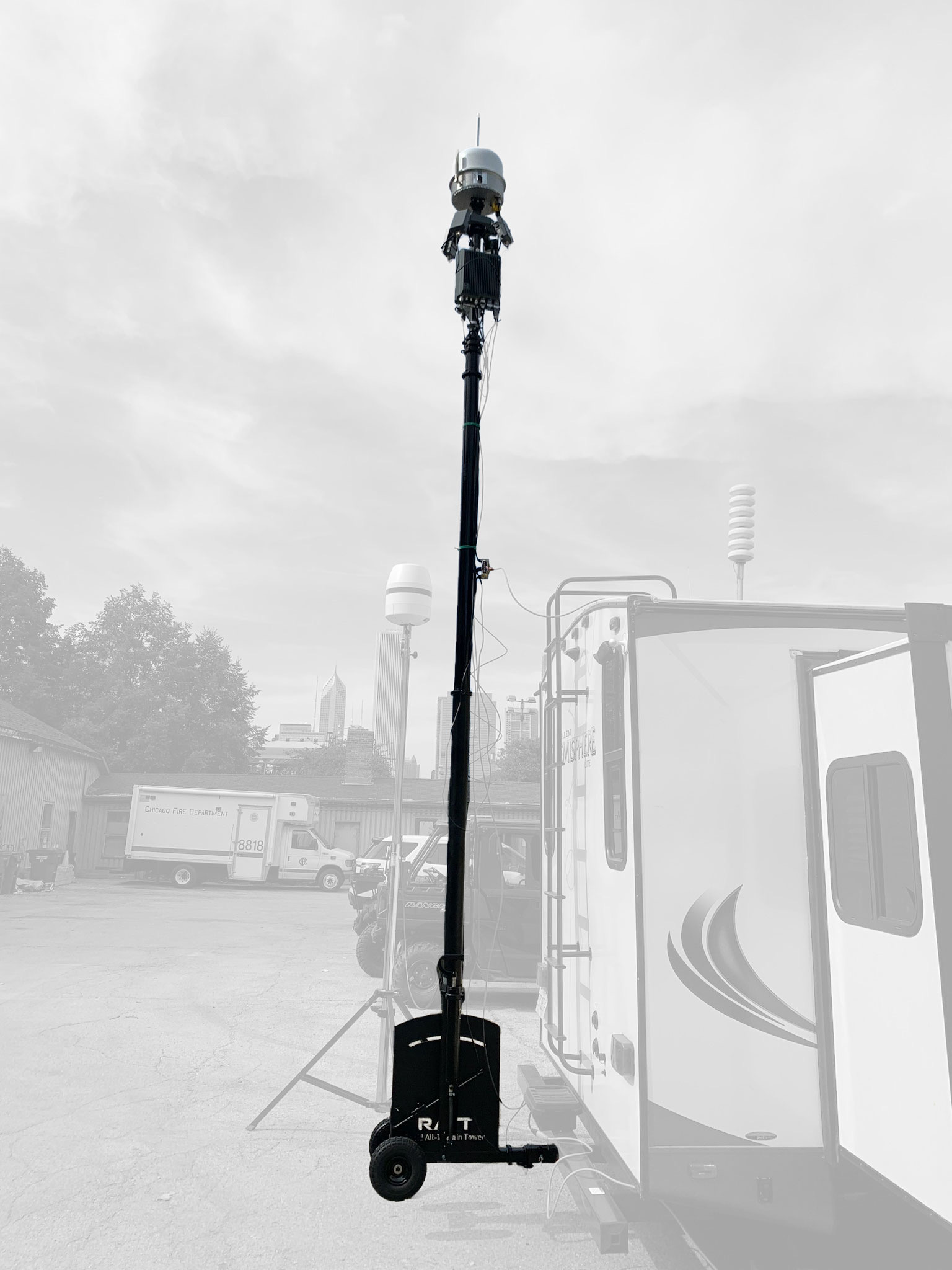
The RATT (Rapid All-Terrain Tower) is a field-swappable mast system that deploys on a vehicle hitch, tripod legs, wall mount, or solar trailer. One mast, any mount, any device. A single officer mounts a counter-drone RF sensor to the mast head, drives to the event site, and has the sensor elevated and scanning in under 10 minutes. No crane. No bucket truck. No construction crew.
For rapid event deployment, the key constraint is payload. The RATT standard mast supports a recommended payload of 35 lbs, which accommodates compact RF detection panels and single-sensor packages. The HD mast supports a recommended 60 lbs, opening the door to mid-range multi-sensor packages that combine RF with a small radar panel or PTZ camera.
Weight is not the only factor. Physical dimensions and wind profile matter just as much. A flat-panel sensor with a large surface area creates more wind load on the mast than a compact cylindrical unit of the same weight. CTS recommends running a wind load analysis on any sensor package before field deployment to confirm mast compatibility under real-world conditions. This is an engineering question, not a guess.
The RATT’s deployment flexibility is what makes it unique in this role. If the threat picture changes mid-event, the same mast can relocate from a vehicle hitch in the parking lot to a tripod on a rooftop in minutes. Gulf Shores Police used exactly this kind of rapid repositioning during their spring break operations. No other mast system on the market offers that kind of field-swappable flexibility across four different mount types.
Sustained Counter-Drone Protection for Facilities and Critical Infrastructure
Events end. Facilities do not. A correctional complex, a border zone, a military installation, a power substation, a water treatment plant. These sites need counter-drone detection that runs for weeks or months without operator intervention or external power.
CTS solar surveillance trailers are purpose-built for this mission. Solar-powered, autonomous, and deployable in 20 to 30 minutes. The fixed mast on CTS trailers supports a recommended payload of 150 lbs, which accommodates the heaviest multi-sensor counter-drone arrays on the market: radar panels, RF analyzers, and EO/IR cameras all mounted on a single mast head. The 48V DC LiFePO4 battery bank sustains operations through extended periods of low sun, and the entire system monitors remotely via cloud-native architecture. No NVR. No camera server. No laptop in the field. Detection alerts stream to a command center from any browser, anywhere.
The capability that no competitor can match is the dual-mast configuration. Every CTS solar trailer includes a 2-inch hitch receiver built into the rear of the frame. That receiver accepts a hitch-mounted RATT mast as a secondary elevation platform. The primary fixed mast carries your counter-drone sensor array. The secondary RATT mast carries surveillance cameras, a second detection sensor for overlapping coverage, or an entirely different payload like lighting or communications equipment. Two masts. One trailer. One deployment. No other manufacturer in the solar surveillance trailer market offers this.
For agencies evaluating sustained counter-drone protection, CTS offers three trailer platforms. The FST-44 at $49,995 features a field-swappable mast with 35 lb payload capacity. The FXT-44 at $59,995 adds a fixed 18-foot mast with remote monitoring. The FXT-46 at $69,995 delivers a 4×6 platform with 1,000W solar, six-camera capacity, and optional generator integration. All three are NDAA/TAA compliant and available through TIPS Contract #230105.
Choosing the Right Deployment Platform for Your Sensor Package
The right platform depends on your mission profile and your sensor’s physical characteristics. Here is how the payload tiers break down.
| Platform | Payload | Best For | Deploy Time |
| RATT Standard Mast | 35 lbs | Compact RF sensors, single-panel detection | Under 10 min |
| RATT HD Mast | 60 lbs | Multi-sensor packages, RF + compact radar or PTZ | Under 10 min |
| Trailer Fixed Mast | 150 lbs | Full multi-sensor arrays: radar + RF + EO/IR | 20 to 30 min |
| Dual-Mast Trailer | 150 + 35/60 lbs | Combined surveillance + counter-drone on one platform | 20 to 30 min |
A critical step that most agencies skip: the wind load analysis. Every sensor has a published weight spec. Fewer publish their physical dimensions and wind profile. A 20 lb sensor with a large flat face can generate more stress on a mast in a 30 mph crosswind than a 35 lb sensor with a compact cylindrical housing. Before any field deployment, CTS recommends providing your sensor’s weight, dimensions, and mounting configuration so we can confirm mast compatibility under wind load conditions specific to your operating environment.
This is the kind of engineering consultation that separates a successful deployment from a mast failure at the worst possible moment. We have been building and deploying mast systems for public safety and military agencies since 2013. We take the wind load question seriously because we have seen what happens when agencies do not.
Integration With Existing Surveillance and Command Systems
A counter-drone sensor that lives on its own screen, with its own login, disconnected from your existing camera feeds and command picture, is a sensor your operators will ignore when things get busy. Integration is not a nice-to-have. It is the difference between detection and detection that leads to action.
CTS platforms are built on an open ecosystem. Every camera and sensor deployed on a CTS mast or trailer connects via ONVIF standard protocols. That means your counter-drone detection feeds integrate directly with Fusus, Motorola CommandCentral Aware, Genetec Security Center, Milestone XProtect, or any standards-based VMS or RTCC platform your agency already operates. No proprietary lock-in. No rip-and-replace.
The architecture is cloud-native. Every CTS deployment includes edge storage (256 GB SD card, upgradable to 1 TB) plus 12 months of cloud storage with 30-day retention. Detection alerts, live video, and recorded footage are accessible from any browser or app on any internet-connected device. No NVR box to maintain. No camera server to rack. No laptop sitting in the rain next to the trailer. Connectivity runs through a public static IP via FirstNet, T-Mobile, or Verizon. The agency provides its own SIM.
What this means in practice: a counter-drone sensor on a CTS trailer at a correctional facility perimeter and a surveillance camera on a RATT mast at a stadium across the state both stream to the same command picture in the same RTCC. One platform. One operational view. That is how detection becomes actionable.
Frequently Asked Questions
What is a counter-drone detection system?
A counter-drone detection system uses one or more sensor technologies (RF, radar, electro-optical/infrared, or acoustic) to detect, track, identify, and locate unauthorized drones in a defined airspace. These systems provide real-time alerts to operators and, depending on configuration, can identify the drone’s make and model, flight path, and in some cases the location of the pilot.
Can state and local law enforcement legally use counter-drone technology?
Detection is legal. Any agency can deploy sensors to detect and track drones in their operating area. Active mitigation is a different story. Jamming, spoofing GPS, or physically intercepting drones is currently restricted to specific federal agencies (DHS, DOJ, DOD, DOE) under existing federal law. State and local agencies can detect, document, and coordinate with federal partners for mitigation. Legislation to expand counter-drone authority to state and local agencies has been introduced in Congress but has not been enacted as of this writing.
How much does a drone detection system cost?
Costs vary significantly based on sensor type and coverage requirements. Basic RF-only detection systems start in the low tens of thousands. Multi-sensor systems with radar, RF, and EO/IR can range from $100,000 to $500,000 or more depending on coverage area and integration complexity. The deployment platform (mast, trailer, power, connectivity) is a separate line item that agencies often underestimate in initial budgeting.
What is the detection range of a portable drone detection system?
Range depends on sensor type and deployment height. RF sensors typically detect drones at 2 to 5 km. Radar can reach 5 to 10 km in open environments. EO/IR cameras provide visual tracking at 1 to 3 km depending on optics. Acoustic systems are limited to 300 to 500 meters. Elevating any sensor on a mast significantly extends its effective range by clearing ground clutter and obstructions.
Do drone detection systems work against autonomous drones?
RF-only systems do not detect fully autonomous drones that fly pre-programmed GPS routes without active communication to a controller. Radar, EO/IR, and acoustic sensors all detect autonomous drones because they sense the drone’s physical presence rather than its radio signal. This is why multi-sensor fusion is critical. Agencies deploying RF-only detection have a growing blind spot as autonomous flight becomes more accessible.
How quickly can a mobile drone detection system be deployed?
On a RATT mast system, a single operator can have a counter-drone sensor elevated and operational in under 10 minutes using a vehicle hitch, tripod, or wall mount. On a CTS solar surveillance trailer, full deployment including mast extension and sensor activation takes 20 to 30 minutes. Both timelines assume the sensor has been pre-mounted and cabled to the mast head.
What is a wind load analysis for mast-mounted sensors?
A wind load analysis evaluates whether a sensor’s weight, physical dimensions, and mounting profile are compatible with a specific mast system under real-world wind conditions. Weight alone does not determine compatibility. A sensor with a large flat surface area can create significantly more stress on a mast in crosswind conditions than a heavier sensor with a compact profile. CTS recommends this analysis before any field deployment to ensure mast integrity and operational reliability.
Ready to Deploy?
Critical Tech Solutions provides the deployment infrastructure for counter-drone detection. From 10-minute rapid deploy at a stadium to weeks of autonomous facility protection on a solar trailer. NDAA/TAA compliant. SOCOM sole source. Selling to public safety and military since 2013.