Understanding AI Facial Recognition in Modern Security
AI facial recognition is a type of biometric security that uses artificial intelligence in security systems to identify or verify individuals based on their distinctive facial features. It relies on facial recognition software that measures the geometry of a person’s face, such as the distance between the eyes, the shape of the nose, and the outline of the jaw, to create a digital profile. The National Institute of Standards and Technology (NIST) regularly gauges the accuracy and performance of facial recognition algorithms used in government and commercial systems.
This technology plays a growing role in public safety, defense, and law enforcement operations. As cities and agencies look for faster and more accurate ways to confirm identities in real time, AI facial recognition offers both efficiency and precision.
According to the U.S. Government Accountability Office (GAO), 20 out of 42 federal agencies that employ law enforcement officers reported owning or using facial recognition technology for investigative and security purposes. This growing adoption across federal operations highlights how widely AI facial recognition is being used to improve situational awareness and streamline identity verification.
How AI Facial Recognition Works
AI facial recognition combines imaging, pattern recognition, and neural networks to analyze and compare facial data. The process usually consists of three steps:
- Capturing facial data
- Converting faces into digital templates
- Matching and verification
Each step relies on clear, high-quality images captured by surveillance cameras.
Capturing Facial Data
The process begins when a camera captures an image or video of a person’s face. These images may come from surveillance systems or access points.
AI algorithms detect the face and isolate it, taking care of lighting, movement, and angles. Machine learning models trained on large sets of images help identify consistent facial landmarks like eye position and cheekbone structure, regardless of lighting or environment.
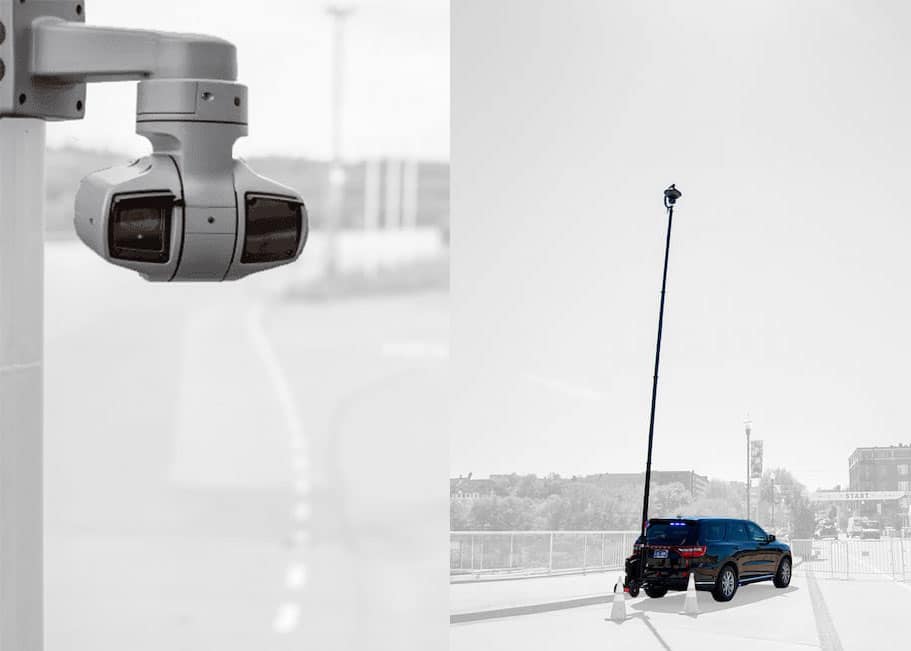
Modern IP cameras provide high-resolution images that increase accuracy and decrease false positives.
Converting Faces into Digital Templates
Once the image is captured, the software maps key features in order to create a biometric identification profile. This process, called facial mapping, measures the distances and angles between facial features to form a mathematical representation of the face.
Instead of storing a photo, the system saves an encrypted digital code, called a faceprint. This code is unique to each individual and cannot be reverse-engineered into an image, protecting privacy.
Matching and Verification
Then it compares the new faceprint with previous records kept in a secure database. There are generally two kinds of comparisons:
- Verification (1:1 match): Confirms a person’s identity by comparing their face to one stored template, such as for secure entry.
- Identification (1:N match): Searches a database to find a possible match, often used in surveillance or investigations.
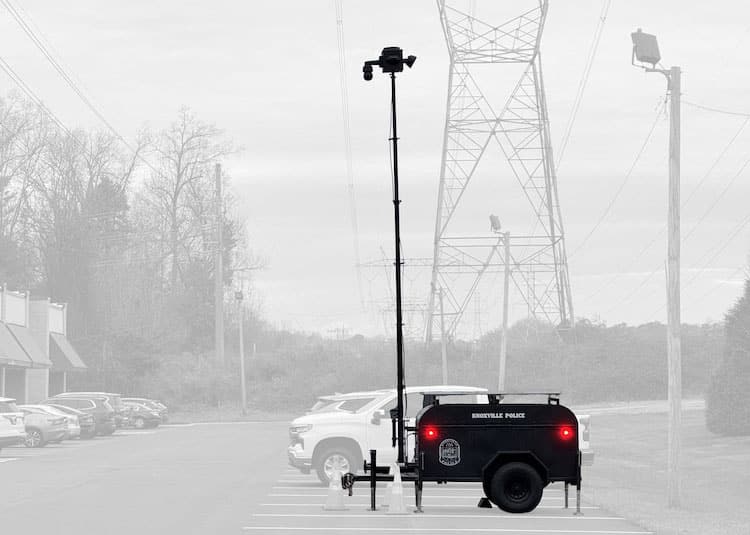
When used with mobile surveillance towers, AI facial recognition can process live video feeds and alert operators immediately when a match is found.
Applications in Public Safety and Security
AI facial recognition supports many safety and defense operations across law enforcement, military, and city systems.
Law Enforcement Use Cases
Facial recognition helps agencies in improving investigations, tracking suspects, and locating missing persons. It can:
- Track people of interest in real time during large events
- Confirm identities quickly during investigations
- Connect with command centers to improve coordination
When integrated with mobile and fixed video systems, it allows officers to analyze footage and confirm identities more quickly. Patrol camera strategies then support these operations through better coordination and response times.
Military and Defense Applications
In defense settings, AI facial recognition software strengthens base security and access control. It can:
- Protect restricted areas by verifying authorized personnel
- Authenticate identities in the field using portable or vehicle-mounted systems
- Improve awareness by linking identification data with operational networks
These capabilities reduce human error and help military teams make faster decisions in high-pressure environments.
City and First Responder Applications
Cities and emergency services use facial recognition software in their surveillance networks to enhance safety. It can:
- Manage crowds during large gatherings
- Monitor traffic and locate stolen vehicles
- Support first responders by verifying identities during evacuations
When combined with light towers and mobile surveillance towers, it extends visibility in low-light conditions. This helps cities manage crowds, traffic, and emergencies more effectively.
In sensitive areas such as schools or stadiums, cameras in schools show how responsible surveillance can protect public spaces while maintaining accountability.
Benefits of AI Facial Recognition
AI facial recognition improves operational efficiency by automating identification and reducing response times. Key advantages include:
- Faster verification and access control
- Ability to analyze thousands of faces at once
- Seamless integration with IoT devices, mobile units, and telescopic masts
- Fewer human errors in manual monitoring
- Greater situational awareness for command teams
These systems can also connect with mobile security platforms to extend field operations and enhance situational awareness.
Challenges and Limitations
Every technology has its challenges, and facial recognition is no different. Being aware of these limits helps agencies deploy the technology responsibly.
Accuracy Concerns
Poor lighting conditions, face masks, and bad angles weaken facial recognition accuracy. While high-quality imaging reduces false positives, environmental factors still matter.
Advanced IP cameras can improve image clarity, but planning and governance remain essential.
Privacy and Ethical Considerations
Because facial recognition uses sensitive data, it must be managed with care. Clear data policies, limited database access, and encryption are important for ethical use. Agencies should prioritize transparency and oversight to maintain public trust.
Future of AI Facial Recognition
AI and deep learning continue to expand what facial recognition can do. Future improvements may include:
- More accurate neural networks trained on larger image sets
- Integration with drones and body-worn cameras
- Predictive analytics for early threat detection
With the improvement of artificial intelligence in security systems, facial recognition will become a more highly valued means for real-time response and coordination.
Conclusion
AI facial recognition is redefining modern security, giving agencies new ways to monitor, verify, and respond. From large-scale events to critical incidents, its precision and automation provide a clear tactical edge.
Contact Critical Tech Solutions to learn how our systems can help integrate AI facial recognition into your surveillance network.