
When emergencies strike, whether from natural disasters, large public gatherings, or public safety threats, Americans tend to support tools that promise faster response and better coordination. In moments of risk, safety often comes first.
As cities expand networks of connected cameras, sensors, and monitoring systems, that instinct meets a quieter question: how much surveillance is too much? Smart city technology can help responders act faster, but it also increases how closely everyday life is observed.
A new survey of 1,000 adults captures this tension clearly. 73.0% say smart surveillance improves emergency response in their city. At the same time, 77.3% worry that those same systems could violate personal privacy. Support and concern are rising together.
Key Findings
- 73.0% say smart surveillance improves emergency response
- 77.3% are concerned it could violate personal privacy
- 83.3% believe surveillance is likely being misused without public knowledge
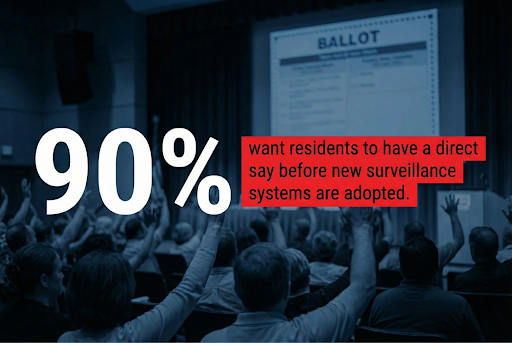
- 90.3% want residents to have a direct say before new surveillance is adopted
- Only 19.2% accept audio recording in public spaces
- 69.9% believe surveillance could suppress protests or free speech
Faster Response Wins Support, But Only in Context
Support for smart surveillance grows when the benefit is immediate and easy to understand. Emergency response stands out as the most important use case.
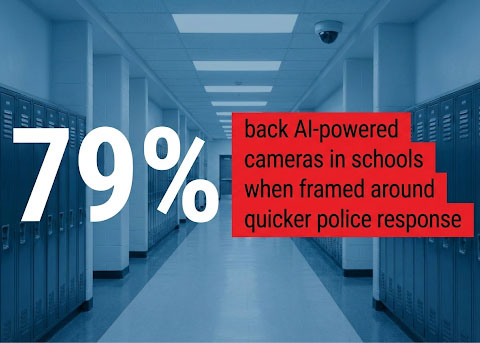
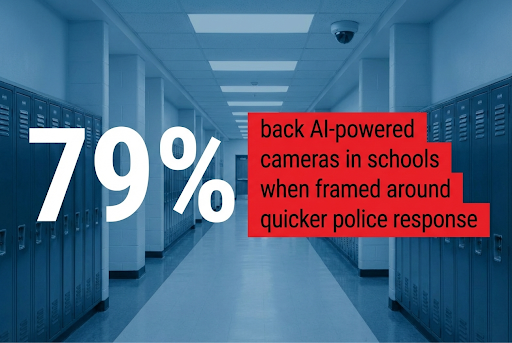
Nearly three-quarters of respondents say connected surveillance systems help emergency services arrive faster. That support increases in specific scenarios. 79.2% back AI-powered cameras in schools when framed around quicker police response, and 69.7% are comfortable with police drones monitoring large public events.
This response reflects familiarity. People already rely on GPS, mobile alerts, and real-time updates in daily life. Surveillance, used as an emergency response technology, feels like another source of information that helps responders see what is happening and act faster.
Still, support is conditional. People are reacting to purpose, not technology. When surveillance is limited to emergencies and framed as time-bound, it feels protective rather than intrusive.
Privacy Concerns Keep Pace With Safety Support
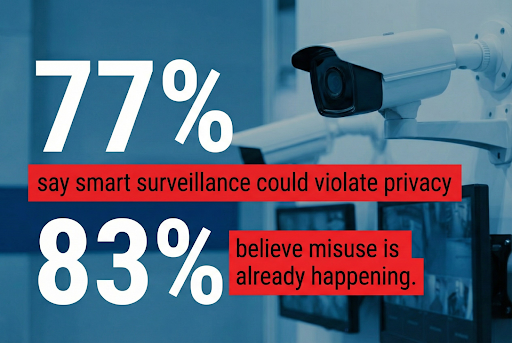
Support for emergency tools does not erase concern. 77.3% say smart surveillance could violate privacy, and 83.3% believe misuse is already happening.
This combination defines the privacy paradox. People can recognize real benefits while doubting the systems meant to control them. Trust in the technology does not automatically extend to trust in how it is managed.
Many Americans already suspect that digital platforms collect more data than they understand. That skepticism carries over to smart city surveillance, especially when residents are not told how data is stored, shared, or deleted.
The concern deepens when transparency is lacking. 63.5% say local governments have not been clear or visible about how smart city technologies are used.
Where People Draw Clear Boundaries
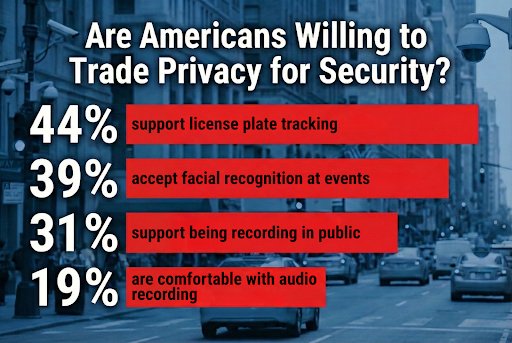
Not all forms of surveillance feel the same to the public. Visual monitoring earns far more acceptance than audio.
When asked what they find acceptable for public safety, 43.9% support license plate tracking, and 38.5% accept facial recognition at events. Acceptance drops sharply after that point. Only 31.2% support being recorded in public, and just 19.2% are comfortable with audio recording.
Nearly 29.8% reject all tradeoffs entirely, saying safety should not come at the cost of privacy. These responses suggest people are not reacting emotionally to surveillance itself. They are judging how invasive it feels.
The steep drop in support for audio recording highlights an intuitive line. Americans expect to be seen in public. They do not expect to be listened to.
Emergency Powers Raise Deeper Civil Liberties Fears
Support becomes more fragile when people consider what happens after an emergency ends.
Nearly 69.9% believe surveillance technologies could be used to suppress protests or free speech. The concern is not limited to immediate use. It centers on expansion over time. Temporary tools have a tendency to stick around.
This fear reflects familiar patterns. Emergency measures often outlast the events that justified them. Even as people support surveillance during crises, they remain wary of how those powers could be reused later.
The issue is not the rejection of safety technology. There is uncertainty about how long it stays in place and how it might be applied outside emergencies.
Consent Matters More Than Institutional Trust
The strongest signal in the survey has less to do with technology and more to do with governance.
An overwhelming 90.3% want residents to have a direct say before new surveillance systems are adopted. That preference cuts across demographics and points to a desire for consent rather than compliance.
Surveillance infrastructure feels permanent once installed. A public vote or approval process feels like the last meaningful opportunity to influence long-term outcomes. Being involved restores a sense of agency, even when people do not fully agree with the result.
Trust remains limited. 28.2% say they do not trust any group to manage surveillance data responsibly. Instead of relying solely on institutions, respondents are calling for visible guardrails, such as clear limits, public involvement, and accountability.
The Double Bind Facing Marginalized Communities
The survey reveals a sharper tension among Black and Hispanic respondents.
These groups are among the most likely to see emergency benefits. 83.7% of Black respondents and 80.6% of Hispanic respondents say smart surveillance improves response. At the same time, they are far more likely to believe surveillance disproportionately targets Black and Latino communities.
This is not a contradiction. It reflects lived experience. For some communities, the promise of protection exists alongside concern about unequal enforcement. Support for emergency tools can coexist with skepticism shaped by history.
Summary: Safety With Boundaries
The public is not rejecting smart surveillance. They are weighing it carefully.
Americans appear willing to accept monitoring when it is narrowly defined, transparent, and clearly tied to emergency response. What they resist is permanence without consent and power without clear limits.
As cities continue to modernize, the question is no longer whether surveillance works. It is whether it can be deployed in a way that protects safety while preserving trust, without forcing people to give up one for the other.
Methodology
This survey was conducted among 1,000 adults. Participants answered questions about smart city surveillance, emergency response, privacy concerns, trust in oversight, and perceptions of fairness. Responses were analyzed across demographic groups to identify patterns and differences.
Fair Use Policy
Users are welcome to utilize the insights and findings from this study for noncommercial purposes, such as academic research, educational presentations, and personal reference. When referencing or citing this article, please ensure proper attribution to maintain the integrity of the research. Direct linking to this article is permissible, and access to the original source of information is encouraged.
For commercial use or publication purposes, including but not limited to media outlets, websites, and promotional materials, please contact the authors for permission and licensing details. We appreciate your respect for intellectual property rights and adherence to ethical citation practices. Thank you for your interest in our research.


