
H.264 vs H.265 vs AV1. Smart compression from Axis, Hanwha, Avigilon, and Pelco. How the AV1 surveillance camera revolution and every layer of the video stack affect what actually works over cellular in the field.
Why Compression Matters More Over Cellular Than Ethernet
On a wired network, compression is a storage conversation. You choose a codec, set a bitrate, and the video travels over gigabit Ethernet with bandwidth to spare. The compression decision affects how much hard drive space you burn through per month. It rarely affects whether the system works.
Over cellular, compression is an operational conversation. The difference between a camera streaming at 8 Mbps and one streaming at 2 Mbps is the difference between a frozen feed during a crowd surge and smooth, usable video that an operator can actually act on. Cellular bandwidth is expensive, shared, and unpredictable. Every megabit you save in compression is a megabit that stays available for the second camera, the radio backhaul, or the Starlink failover.
This is the reality for any agency deploying cameras on a rapid-deploy mast or solar surveillance trailer. There is no Ethernet jack in a parking lot, on a rooftop, or at a beachfront staging area. The cameras stream to cloud storage or an RTCC platform over bonded cellular and satellite connections. Compression is not a spec sheet number. It determines whether the deployment delivers actionable video or an expensive disappointment. Understanding what drives remote surveillance trailer cost starts here.
The good news: the compression landscape just changed dramatically. A new video codec called AV1, combined with smart compression technologies from every major camera manufacturer, can reduce bandwidth requirements by 75% or more compared to raw H.264. For agencies streaming surveillance over cellular, this is the most significant technology shift in a decade. Here is how it works and what it means in the field.
H.264 vs H.265 vs AV1: What Each Codec Actually Does
A video codec compresses raw footage so it can be transmitted and stored. Without compression, a single 4K camera would generate over 700 GB of data per day. Codecs make that manageable. The question is how much they compress and at what cost.
H.264 (AVC): The Workhorse
Released in 2003, H.264 is the most widely deployed video codec in the world. Every camera supports it. Every VMS decodes it. Every browser plays it. That universal compatibility is its greatest strength and the reason it remains the default on most surveillance systems today. The limitation is efficiency. H.264 was designed when 720p was considered high resolution and bandwidth was relatively cheap. At 4K, H.264 streams can consume 8 to 12 Mbps or more. Over cellular, that is a problem.
H.265 (HEVC): The Efficiency Upgrade
Released in 2013, H.265 delivers roughly 50% better compression than H.264 at the same visual quality. A 4K camera that needed 10 Mbps on H.264 can stream comparable footage at 5 Mbps on H.265. That is a meaningful reduction for cellular deployments. However, H.265 comes with complex licensing requirements that have slowed adoption, particularly in web browsers. Firefox still does not ship with an H.265 decoder. This creates friction for agencies that need browser-based remote access to their cameras.
AV1: The Game Changer
AV1 was developed in 2018 by the Alliance for Open Media, a consortium founded by Google, Netflix, Amazon, Apple, Microsoft, and Intel. It delivers 30 to 50% better compression than H.265 while being completely royalty-free. Every major web browser supports AV1 natively. Every major operating system decodes it. And because there are no licensing fees or restrictions, AV1 adoption is accelerating across the entire video ecosystem.
For surveillance, the practical impact is straightforward: an AV1 surveillance camera streaming 4K can deliver the same forensic-quality video as H.264 at roughly one-quarter to one-third the bandwidth. Over cellular, that is transformative. And because AV1 is browser-native, agencies can view their cameras from any device without installing proprietary software or codec packs.
The catch: AV1 requires newer hardware to encode efficiently. It is computationally heavier than H.264 or H.265, which means cameras need dedicated silicon to process it in real time. This is not a firmware upgrade for existing cameras. It arrives on the next generation of camera processors. Axis Communications is the first surveillance camera manufacturer to ship AV1 in production cameras, powered by their ARTPEC-9 system-on-chip.
| H.264 | H.265 | AV1 | |
| Released | 2003 | 2013 | 2018 |
| Typical 4K Bitrate | 8-12 Mbps | 4-6 Mbps | 2-4 Mbps |
| Savings vs H.264 | Baseline | ~50% | 65-80% |
| Licensing | Licensed | Complex licensing | Royalty-free |
| Browser Support | Universal | Partial (no Firefox) | Universal |
| Camera Hardware | All cameras | Most modern cameras | New generation only |
| Best For | Max compatibility | Balanced efficiency | Cellular and cloud |
Smart Compression: The Layer That Stacks on Top of the Codec
A codec compresses every pixel in the frame equally. Smart compression does something fundamentally different. It analyzes the scene in real time, identifies what matters (a face, a license plate, a person walking through a parking lot), and allocates bandwidth to those regions while compressing everything else more aggressively. The background wall gets fewer bits. The suspect’s face gets full resolution.
This is not a replacement for the codec. It works on top of it. You choose a codec (H.264, H.265, or AV1), then smart compression optimizes the stream within that codec’s framework. The result is a compounding effect: the codec reduces bandwidth by a percentage, and smart compression reduces it further. The two layers stack.
Every major camera manufacturer that Critical Tech Solutions (CTS) works with has developed its own proprietary smart compression. The technology names differ. The core concept is the same. Here is how each one works.
Axis Zipstream
Axis Zipstream is included in every Axis camera and is compatible with H.264, H.265, and AV1 simultaneously. It uses three techniques working together. Dynamic ROI (regions of interest) automatically identifies people, vehicles, and motion in the scene and preserves those areas at full quality while compressing the static background harder. Dynamic GOP extends the interval between full reference frames when there is no motion, dramatically cutting bandwidth during quiet periods. And dynamic FPS reduces the frame rate during low-activity scenes without losing detail when something happens.
Axis claims Zipstream reduces bandwidth by 50% or more compared to standard compression. In practice, the savings vary by scene complexity, but the technology is well-documented in Axis’s Zipstream white paper. The critical detail for cellular deployments: Zipstream stacks on top of AV1. A camera running AV1 with Zipstream enabled delivers the 30-50% codec improvement from AV1 plus the 50%+ scene-aware compression from Zipstream. That compounding effect can reduce total bandwidth by 75% or more compared to raw H.264. For a 4K PTZ camera on a mast streaming over a single cellular connection, that is the difference between a system that works and one that stutters.
Hanwha WiseStream III
Hanwha WiseStream III takes an AI-driven approach. Powered by the camera’s onboard AI engine, WiseStream III identifies and classifies objects in the scene (people, faces, vehicles, license plates) and applies different compression rates based on the significance of each object. High-value targets get full quality. The empty parking space behind them gets compressed harder. Combined with H.265, Hanwha claims up to 75% bandwidth savings compared to H.264 alone. WiseStream III does not currently support AV1, though Hanwha published a white paper on AV1 codec application in March 2026, signaling that AV1 support is on their roadmap.
Avigilon HDSM SmartCodec
Avigilon’s HDSM SmartCodec separates foreground objects from the background image in real time. Foreground elements (people, vehicles, anything in motion) retain full image quality. Background areas receive higher compression. When the scene goes completely static, Idle Scene Mode drops the bitrate even further. Avigilon claims up to 50% bandwidth reduction compared to standard H.264. HDSM SmartCodec currently operates with H.264 and H.265 codecs.
Pelco Smart Compression
Pelco’s Smart Compression focuses on dynamic GOP optimization. The camera analyzes motion in real time and automatically reduces the frequency of bandwidth-intensive I-frames in low-motion scenes. In environments like storage rooms or hallways with limited activity, Pelco claims up to 70% bandwidth savings. In busier scenes with constant motion, the savings are more modest but still meaningful. Smart Compression works with H.264 and H.265 across Pelco’s Spectra, Sarix Enhanced, and Optera camera lines.
| Manufacturer | Smart Compression | Codecs | Savings | AV1 Status |
| Axis | Zipstream | H.264, H.265, AV1 | 50%+ | Shipping (ARTPEC-9) |
| Hanwha | WiseStream III | H.264, H.265 | Up to 75% | White paper stage |
| Avigilon | HDSM SmartCodec | H.264, H.265 | Up to 50% | Not available |
| Pelco | Smart Compression | H.264, H.265 | Up to 70% | Not available |
The Stacking Effect: AV1 + Zipstream
This is where the math gets interesting for anyone deploying cameras over cellular.
A 4K PTZ camera streaming raw H.264 at default settings typically produces 8 to 12 Mbps. Switch the codec to AV1 and that drops to roughly 3 to 5 Mbps. A 50-60% reduction from the codec change alone. Now enable Axis Zipstream on top of AV1. Zipstream analyzes the scene and compresses static areas harder while preserving forensic detail in regions of interest. That cuts the remaining stream by another 50% or more, depending on scene complexity.
The result: a 4K PTZ camera that would have consumed 10 Mbps on raw H.264 can deliver comparable forensic-quality video at 1.5 to 3 Mbps on AV1 with Zipstream. That is a 70 to 85% total reduction. In practical terms, it means a single bonded cellular connection can comfortably carry two 4K PTZ cameras simultaneously. On raw H.264, it would struggle to carry one.
Axis documented the streaming performance of ARTPEC-9 in a January 2026 white paper. The extended configuration of ARTPEC-9 can deliver up to three simultaneous 4K streams at 30 fps or eight simultaneous 1080p streams at 30 fps using AV1, H.264, or H.265. AV1’s performance is on par with H.264 and H.265 in terms of stream count despite its higher computational complexity, because the ARTPEC-9 silicon was designed from the ground up to handle AV1 encoding efficiently.
For agencies still on H.264 or H.265 cameras, upgrading to any manufacturer’s smart compression (Zipstream, WiseStream, HDSM SmartCodec, or Pelco Smart Compression) is the fastest way to cut bandwidth today. For agencies building new systems or refreshing hardware, AV1 with Zipstream on Axis ARTPEC-9 cameras represents the current best-in-class compression stack for cellular-deployed surveillance.
From Camera to Cloud: How Compression and Connectivity Work Together
Compression is one half of the equation. The other half is the connectivity pipeline that carries the compressed stream from the mast to the cloud. On a CTS deployment, these components work together in a chain.
The camera sits atop the mast. It runs the codec (H.264, H.265, or AV1) and the smart compression (Zipstream, WiseStream, HDSM SmartCodec, or Pelco Smart Compression) in real time. All cameras CTS deploys are IP and PoE. The video stream travels down the mast via Ethernet cable to the base.
The router receives the compressed stream and transmits it over bonded cellular connections. CTS deploys either the Sierra Wireless XR60 or Peplink BR1 Mini as the default router depending on customer preference and existing tech stack. Upgraded configurations use the Sierra XR80 or Peplink BR2 Pro. Multiple cellular carriers (T-Mobile, Verizon, AT&T/FirstNet) can be bonded together using Peplink SpeedFusion technology, which combines bandwidth from separate SIM cards into a single aggregated connection with automatic failover. Starlink satellite connectivity provides a completely independent backup path when all terrestrial cellular networks are congested or unavailable.
The router also broadcasts Wi-Fi 6 on 2.4 GHz and 5 GHz bands. An included tablet (on RATT mobile surveillance towers) or optional add-on tablet (on solar trailers) connects to the local LAN for zero-latency monitoring and camera control. The operator standing at the base of the mast sees the live feed with no cellular round-trip delay. This local access is independent of the cellular connection and works even if the internet goes down entirely.
Cloud storage receives the stream at the other end. CTS ships every camera with a 256 GB SD card (upgradable to 1 TB) for edge recording plus 12 months of cloud storage with 30-day retention through ACS Edge. No NVR. No camera server. No laptop required. The video is accessible from any browser or mobile app, anywhere. This cloud-native architecture is why compression matters so much. Every byte the camera sends travels over a metered cellular connection to a cloud platform. The less data the camera generates, the more reliable and affordable the entire system becomes.
CamStreamer adds another capability for agencies that need public-facing livestreams. CamStreamer runs as an ACAP application directly on Axis cameras. It converts the camera’s native RTSP stream into RTMP, HLS, SRT, or MPEG-TS without any external hardware. On ARTPEC-9 cameras, CamStreamer supports AV1 streams. This means a camera on a CTS solar trailer can livestream to YouTube, a city website, or a public transparency portal while simultaneously recording to edge and cloud storage. All from a single camera on a single mast.
Where It All Comes Together: Mast and Trailer Deployments
CTS deploys cameras on both The RATT rapid-deploy mast and solar surveillance trailers. The compression and connectivity stack is the same. The deployment architecture differs by platform.
The RATT (Rapid All-Terrain Tower)
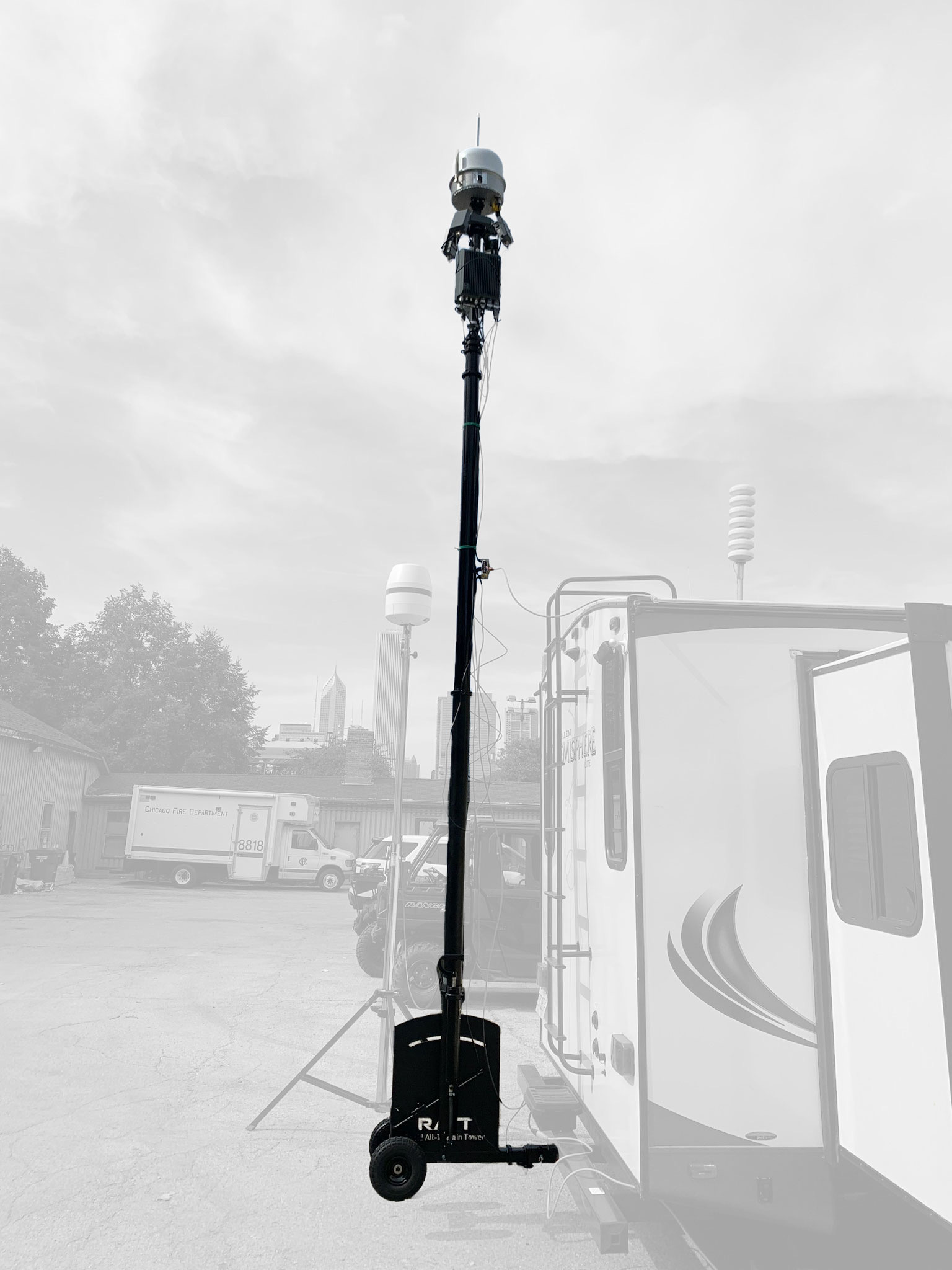
The camera mounts atop the mast. Ethernet runs down to a Pelican-mounted enclosure at the base containing the cellular router with integrated 5G and Wi-Fi 6 antenna, plus an industrial 802.3bt PoE++ hub that delivers up to 60W per port from a 12V DC input. The 12V-to-54V boost technology means CTS can power high-draw 4K PTZ cameras directly from vehicle or battery power without a separate 48V supply. The entire system deploys from a vehicle hitch, tripod, or wall mount in minutes. A single operator can have a 4K PTZ camera streaming to the cloud over bonded cellular in under 10 minutes. The included tablet connects to the router’s Wi-Fi for immediate local monitoring.
CTS developed a custom wind-optimized enclosure for mast-mounted pole cameras. The four-sided aluminum pole camera used on the FST-44 trailer with dual PTZ cameras is field-swappable between the FST-44 mast and all three RATT mount configurations (hitch, tripod, wall). One pole camera, any platform.
Solar Surveillance Trailers
The FXT-44 and FXT-46 trailers use a larger eight-sided steel pole camera enclosure bolted to the fixed mast that supports up to 165 lbs. The NEMA-rated enclosure houses the cameras, router, antenna, and PoE++ hub in a single self-contained unit atop the mast. This is the same pole camera architecture that law enforcement agencies deploy on utility poles for overt fixed surveillance. CTS builds it into the trailer mast instead, making it mobile.
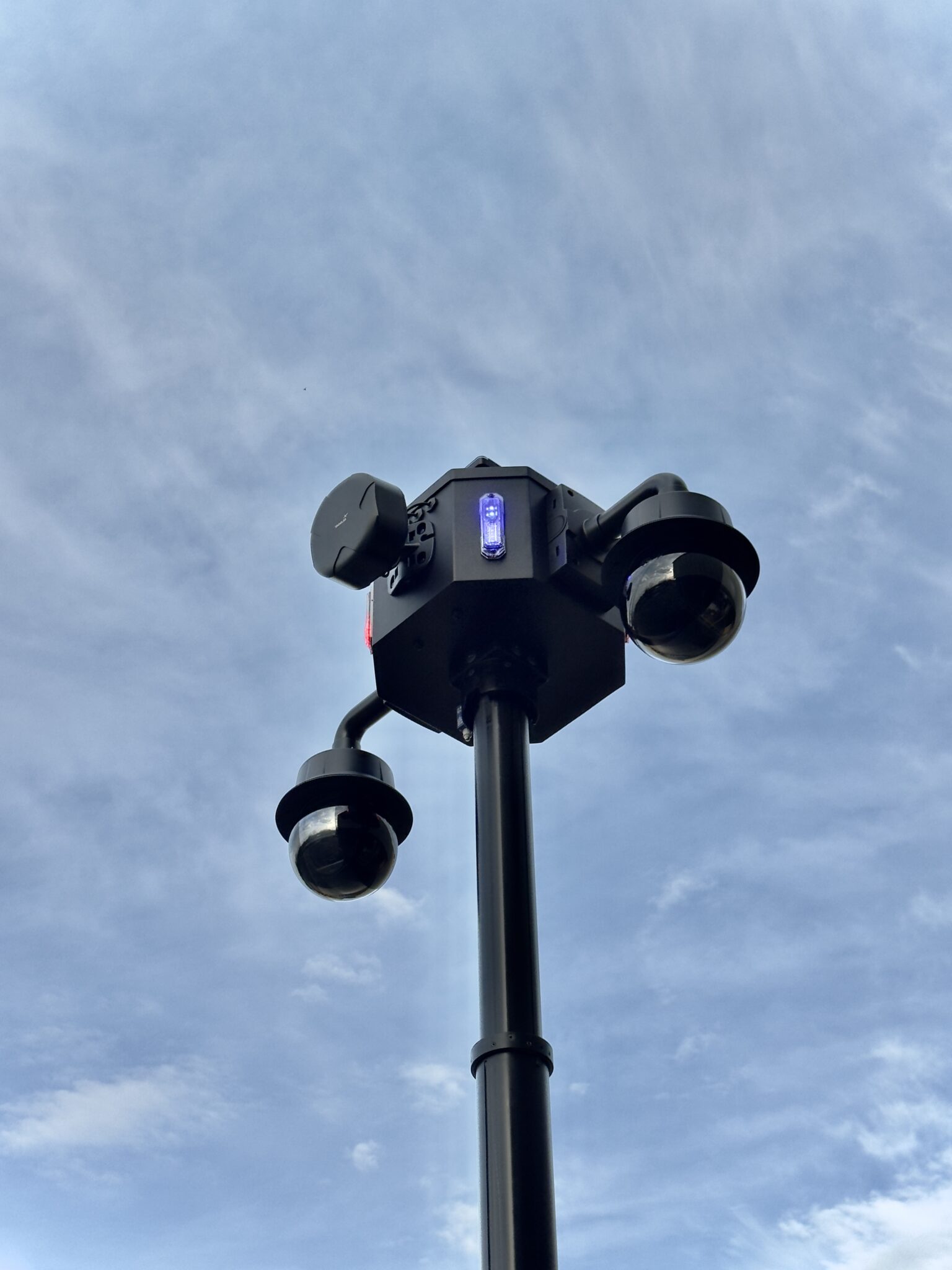
A CTS FXT-44 solar surveillance trailer deployed by the Gulf Shores Police Department. The pole camera atop the mast houses cameras, router, antenna, and PoE++ hub in a single NEMA-rated enclosure.
Regardless of platform, the compression stack is identical: camera codec (H.264/H.265/AV1) plus smart compression (Zipstream, WiseStream, HDSM SmartCodec, or Pelco Smart Compression) plus bonded cellular transport (Peplink or Sierra Wireless) plus cloud storage (ACS Edge). Every improvement in compression directly translates to better video quality, lower data costs, and more reliable operation in the field. The same principles apply to counter-drone sensor feeds and any other device streaming video from elevation.
Not sure which platform fits your agency’s deployment? The CTS platform selection guide walks through the decision.
In the Field: Deployments Running This Stack
Gulf Shores Police Department
The Gulf Shores Police Department deployed a CTS FXT-44 solar surveillance trailer and RATT RQ621 for spring break 2026 on the Alabama Gulf Coast. The trailer runs dual Axis Q6325-LE PTZ cameras (ARTPEC-9, 31x optical zoom, 820-foot IR, AV1 with Zipstream) streaming over Starlink Mini and T-Mobile Priority 5G bonded via Peplink SpeedFusion. Each camera records to a 1 TB SD card on the edge and simultaneously streams to the cloud. The result: 6 firearms seized and 18+ arrests during a multi-week operation. The cameras streamed continuously over bonded cellular and satellite without interruption.
Without AV1 and Zipstream, those dual 4K PTZ cameras would have consumed the entire Starlink Mini bandwidth allocation. With the compression stack enabled, both cameras streamed comfortably with bandwidth to spare for the Wi-Fi LAN, officer devices, and a Peplink SpeedFusion failover path through T-Mobile.
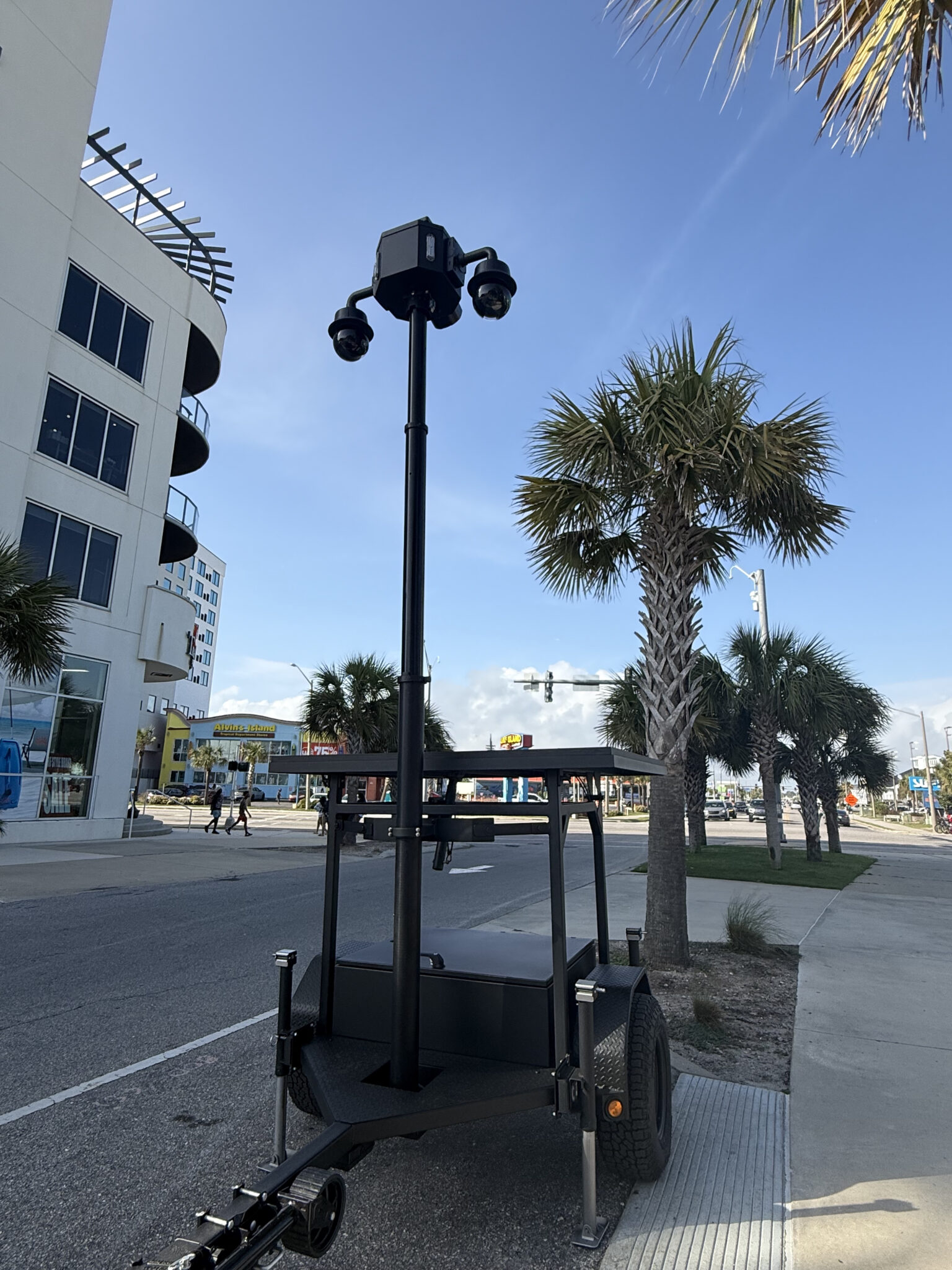
Gulf Shores Police Department FXT-44 trailer deployed during spring break 2026, streaming dual 4K PTZ cameras over bonded Starlink and T-Mobile 5G.
State Highway Patrol Deployment
CTS is currently building multiple trailers for a state highway patrol agency that will carry dual Axis Q6358-LE PTZ cameras. The Q6358-LE is Axis’s newest ARTPEC-9 camera: 4K UHD at 60 fps, 31x optical zoom, 984-foot IR illumination, AV1 with Zipstream, FIPS 140-3 Level 3 certified secure key storage, and a deep learning processing unit for edge analytics including object classification and autotracking. The trailers will bond three cellular carriers (T-Mobile, Verizon, and AT&T/FirstNet) through Peplink SpeedFusion for maximum uptime and bandwidth. Delivery is expected end of April 2026.
Pole Camera Deployments Over Cellular
The same compression principles apply to fixed pole camera deployments. CTS has deployed 17 Avigilon Alta H5A Multisensor pole cameras for a Tennessee police department, strategically mounted on utility poles in high-crime areas and connected back to a Command Central Aware real-time crime center via FirstNet cellular. When your backhaul is cellular rather than fiber, every bandwidth optimization matters. Whether the camera sits on a utility pole, a RATT mast, or a solar trailer, the compression stack determines how much useful video reaches the command center.
Frequently Asked Questions
What is AV1 video compression?
AV1 is a royalty-free video codec developed by the Alliance for Open Media. It delivers 30 to 50% better compression than H.265 and 65 to 80% better compression than H.264 at the same visual quality. AV1 is supported natively by all major web browsers, operating systems, and mobile platforms. Axis Communications is the first surveillance camera manufacturer to ship AV1 in production cameras using their ARTPEC-9 system-on-chip.
Which surveillance cameras support AV1?
As of early 2026, Axis Communications cameras with the ARTPEC-9 processor support AV1 encoding. This includes the Q6325-LE, Q6358-LE, and other ARTPEC-9 models. Other major manufacturers including Hanwha Vision have published AV1 research but have not yet shipped AV1-capable cameras. AV1 adoption is expected to expand across the industry over the next two to three years as new camera processors are released.
What is Axis Zipstream?
Axis Zipstream is a smart compression technology included in every Axis camera. It analyzes each video frame in real time and preserves forensic-quality detail in regions of interest (people, vehicles, motion) while compressing static background areas more aggressively. Zipstream works on top of H.264, H.265, and AV1 codecs simultaneously. Axis claims bandwidth and storage savings of 50% or more compared to standard compression.
How much bandwidth does a 4K surveillance camera use over cellular?
A 4K PTZ camera on raw H.264 typically consumes 8 to 12 Mbps. With H.265, that drops to approximately 4 to 6 Mbps. With AV1, approximately 2 to 4 Mbps. With AV1 plus Axis Zipstream, approximately 1.5 to 3 Mbps depending on scene complexity. Smart compression from other manufacturers (Hanwha WiseStream, Avigilon HDSM SmartCodec, Pelco Smart Compression) delivers similar reductions on H.264 and H.265 streams.
Can you stream surveillance video over cellular?
Yes. CTS deploys all remote surveillance systems over cellular connectivity. Routers from Sierra Wireless and Peplink bond multiple cellular carriers (T-Mobile, Verizon, AT&T/FirstNet) into a single aggregated connection with automatic failover. Starlink satellite provides an independent backup path. Combined with AV1 and smart compression, dual 4K PTZ cameras can stream reliably over bonded cellular with bandwidth to spare.
What is the best video codec for security cameras in 2026?
For new deployments streaming over cellular or to the cloud, AV1 with smart compression (such as Axis Zipstream) delivers the best compression efficiency currently available. For agencies with existing H.264 or H.265 cameras, enabling manufacturer smart compression (Zipstream, WiseStream, HDSM SmartCodec, or Pelco Smart Compression) is the most impactful upgrade that requires no hardware change. H.264 remains the safest choice for maximum VMS and device compatibility across legacy systems.
Does AV1 work with all video management systems?
Not yet. Some VMS platforms are still adding AV1 decoding support. Cloud-native platforms like ACS Edge, which CTS deploys as the default VMS, are well-positioned for AV1 because AV1 was designed for cloud and browser-based delivery. Major VMS vendors including Milestone and Genetec are actively integrating AV1 support. For agencies where VMS compatibility is a concern, cameras can run AV1 for cloud streaming while simultaneously providing an H.264 or H.265 stream for legacy systems.
Ready to deploy cameras that make the most of every megabit? CTS configures every system with the right compression stack for your connectivity environment. NDAA/TAA compliant. TIPS Contract #230105.