
For military units, first responders, and public safety teams, a DAS is more than a convenience. It plays a major role in continuity of command, mission readiness, and time-sensitive response. Without a distributed antenna system, secure wireless communication inside hardened structures becomes unreliable or completely unavailable.
This article explains how DAS works, why it matters for mission-critical operations, and where it delivers the most value. It also connects to related topics such as BDAs, DAS, and portable towers to give teams a fuller understanding of today’s communication options.
How DAS Works and How It Compares to Other Solutions
A modern DAS has several elements working together to deliver strong, stable signals across a space:
- Signal source – a base station, donor antenna, or on-site radio system provides the original RF signal.
- Bi-directional amplifiers (BDAs) – boost signals traveling both from and to the user.
- Remote antenna nodes – small antennas placed throughout the structure to distribute the signal evenly.
- Fiber or coax distribution lines – connect all components to maintain high network uptime.
Different DAS architectures can support a wide range of communication needs:
Types of DAS
- Passive DAS – Uses splitters and coaxial cabling. Cost-effective but harder to scale.
- Active DAS – Uses fiber, remote radio units, and digital management. Best for large military bases or ships.
- Hybrid DAS – Blends both approaches for multi-building or mixed-environment deployments.
DAS vs. Other Communication Solutions
| Technology | Best Use Case | Limitations |
| Two-way radio repeaters | Simple radio coverage | Limited for multi-band or multi-floor communication |
| Cellular boosters | Improve commercial cell service | Not suitable for secure military communication |
| Distributed Antenna Systems | Full-building, multi-band, secure wireless communication | Requires site design and installation |
Compared to repeaters or single-band boosters, a distributed antenna system covers more complex environments and supports a broader mix of radios and devices.
DAS becomes the right choice when teams need:
- Reliable coverage across large, reinforced areas
- Multi-band support for UHF, VHF, LTE, and P25
- Controlled coverage for secure environments
- Redundancy for operational continuity
Operational Gains for Secure, Reliable Communications
Mission-critical communication cannot fail.
A well-designed DAS strengthens mission-critical connectivity through:
1. Reliability
- Eliminates dead zones and isolated rooms
- Maintains low latency for time-sensitive communications
- Supports seamless handoffs as personnel move through a facility
- Creates pathways for network redundancy
During major disasters, communications infrastructure can fail at scale. During Hurricane Michael, FCC disaster reports showed that over 66% of cell sites in Bay County and nearly 70% in Gulf County were out of service, disrupting response coordination. These failures highlight the need for dependable indoor and underground coverage in mission-ready environments.
2. Security
Modern DAS platforms support:
- Encrypted channels
- Controlled coverage zones
- Interference mitigation
- Logging, auditing, and system monitoring
These tools align with the principles of a strong system security plan and support the secure handling of sensitive information. They help teams maintain secure wireless communication by limiting unauthorized access and reducing the risk of signal disruption.
3. Performance
DAS systems reduce interference and maintain high network uptime. They also support:
- UHF, VHF, LTE, 5G, and P25 radio
- Multi-carrier and multi-band operation
- Secure tunnel-to-room connectivity
- High throughput for data, sensors, and surveillance systems
Research sponsored by the U.S. Department of Homeland Security and conducted by NTIA and NIST found that wide-area public safety LTE networks do not provide complete in-building coverage on their own. To achieve reliable performance, these networks must be supplemented with solutions such as small cells and distributed antenna systems.
This makes public safety DAS systems essential in hardened facilities, where radios and field equipment, including P25 gear used by first responders, rely on stable in-building connectivity. While DAS improves performance across many environments, its impact is greatest where traditional signals consistently fail.
Where DAS Delivers in Defense and Public Safety
DAS is especially valuable in environments where traditional radios or cellular networks struggle. Each operational setting creates unique challenges that distributed antenna systems solve through strategic signal distribution, rugged equipment, and interference mitigation.
Bases and Command Centers
Large military bases rely on fast coordination across logistics teams, security offices, operations centers, and maintenance facilities. But these structures often include reinforced concrete, metal infrastructure, and long corridors, all of which weaken or block RF signals.
A DAS improves mission effectiveness by:
- Supporting base-wide communication across multiple buildings
- Maintaining low latency for command and control
- Strengthening indoor coverage in protected areas like armories, hardened data centers, and planning rooms
- Reducing communication gaps between administrative spaces and operational wings
These systems also integrate easily with surveillance systems, including approaches covered in our article on police patrol security camera strategies.
Underground Bunkers and Tunnels
Signals naturally weaken as they pass through earth and dense metals. In underground structures, natural penetration is almost zero. That makes communication nearly impossible without an engineered solution.
A DAS solves this by:
- Creating controlled signal distribution throughout the bunker
- Providing corridor-to-room coverage
- Maintaining stable communication during emergencies
- Supporting secure wireless communication networks that stay active even if above-ground infrastructure fails
These networks also improve operational tracking, allowing commanders to monitor personnel movement and maintain situational awareness during critical events.
Naval and Maritime Environments
Naval vessels present a unique communication challenge: steel hulls, multiple decks, narrow passageways, and heavy equipment all weaken radio and cellular signals. That can cause delays between bridge, operations, and engine room personnel.
A naval-grade DAS:
- Moves RF signals reliably across multiple decks
- Reduces interference from onboard machinery
- Delivers secure communication channels for ship-to-shore and internal operations
- Supports multi-band communication kits used in maritime missions
Because vessels cannot rely on external towers, distributed antenna systems offer the internal coverage needed for safety, command, and emergency coordination.
Forward Operating Bases (FOBs)
Forward operating bases require systems that can deploy quickly, withstand harsh weather, and scale as operations change. DAS for military communications brings structure to communication networks that would otherwise depend on limited repeaters.
Key advantages include:
- Rugged, field-ready nodes that withstand heat, sand, moisture, and vibration
- Rapid deployment with minimal infrastructure
- Scalable layouts that support temporary shelters, mobile command posts, and perimeter control
- Integration with tactical surveillance equipment, such as those highlighted in essential military surveillance equipment
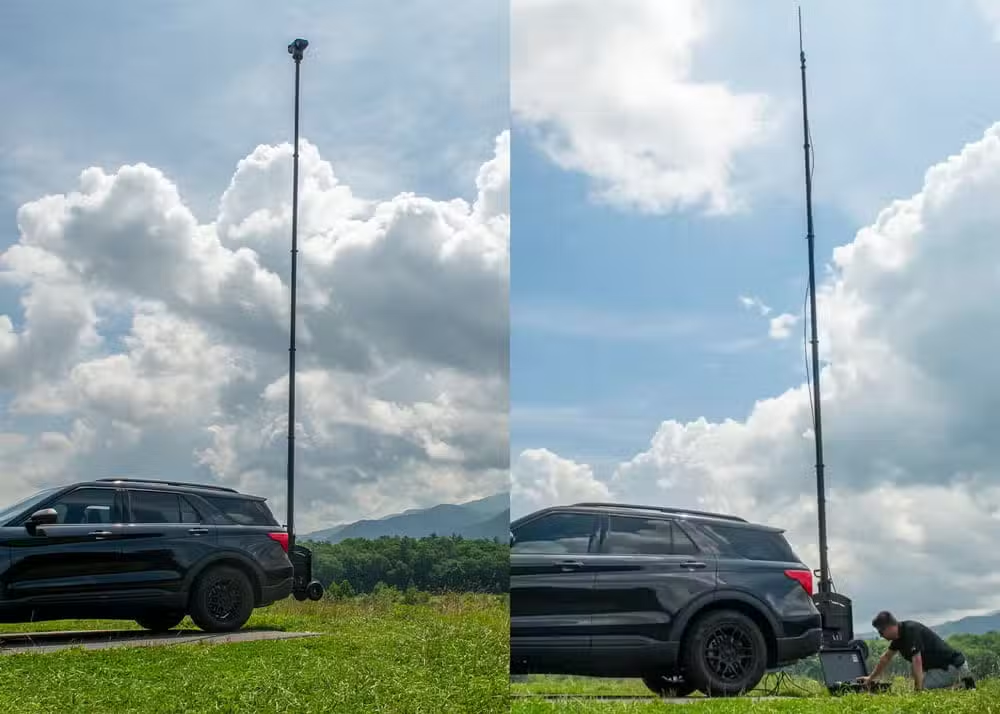
Many forward operating bases also pair DAS infrastructure with rapid-deploy mast platforms like The RATT, which carry P25 antennas, LTE routers, and signal boosters to elevated positions in under 10 minutes and extend tactical coverage beyond the building footprint.

These deployments often work alongside mobile situational awareness tools, including mobile video surveillance systems used to reinforce security and help teams avoid common mobile surveillance mistakes.
Implementation and Partner Selection
Designing a DAS system requires planning, testing, and expert configuration, especially when the goal is mission-critical reliability.
Key Design Considerations
- RF site surveys
- Band planning and interference mitigation
- Antenna node placement
- Power and backup planning
- Redundancy loops for high availability
- Performance testing and documentation
A strong DAS design also integrates with other tactical infrastructure, including telescopic mast systems used to support distributed antenna configurations beyond the primary structure. It supports communication kits, field-deployed surveillance tools, and other mission-critical equipment that strengthens secure communication systems.
Integration With Tactical Networks
DAS performance improves when paired with:
- Command-center systems
- Secure network backbones
- Surveillance platforms
- Ruggedized communication kits
- Portable or mast-mounted nodes
This creates a unified operational picture that supports decision-making, situational awareness, and incident response.
What To Look For in a Provider
- Experience with military and public safety environments
- Secure configuration practices
- End-to-end documentation
- Service-level agreements (SLAs)
- Lifecycle support
- Access to authorized partner technology from established manufacturers like Motorola Solutions, Axis Communications, Hanwha Vision, and Pelco
The right partner understands communication systems from planning to deployment and supports mission goals without adding complexity.
Critical Tech Solutions has supported military and public safety communication missions since 2013. As a SOCOM sole source contract winner, CTS supplies rapid-deploy mast platforms and surveillance systems that complement fixed DAS infrastructure where indoor coverage gives way to outdoor, forward, or mobile operations. Procurement teams can buy through sole source or TIPS Contract #230105, with NDAA and TAA compliant IP-based components built for federal deployment standards.
Conclusion
A Distributed Antenna System provides consistent, secure coverage in environments where communication cannot fail. For military and public safety teams, reliable signal distribution supports command continuity, faster response, and safer operations. When designed and integrated correctly, DAS becomes a core part of mission-ready communication infrastructure.
If your team needs to extend DAS coverage to forward positions, mobile units, or outdoor perimeters, explore The RATT or contact us to discuss how our solutions support your communication mission.
Frequently Asked Questions
What is the difference between a BDA and a DAS?
A BDA (Bi-Directional Amplifier) is a single device that boosts radio signals in both directions, from the user to the base station and back. A DAS (Distributed Antenna System) is the broader network that uses BDAs along with antenna nodes, fiber, and coax to distribute that boosted signal evenly throughout a building or complex. Most large public safety and military DAS deployments include one or more BDAs as part of the signal source.
Is a distributed antenna system the same as a cellular booster?
No. A cellular booster is a single-zone consumer or small-business product designed to improve signal in a confined area like one room or a vehicle. A DAS is engineered for full-building, multi-band, multi-carrier coverage and is the only practical solution for hardened military facilities, hospitals, stadiums, and other large structures where a single booster cannot deliver consistent coverage.
Do military bases use DAS systems?
Yes. Military bases use DAS extensively to maintain reliable communications inside reinforced buildings, command centers, hangars, hardened data centers, and underground bunkers. DAS supports multi-band radio (UHF, VHF, LTE, P25), encryption, and controlled coverage zones that meet operational and security requirements specific to defense environments.
What is the difference between active DAS and passive DAS?
Passive DAS uses splitters and coaxial cable to distribute RF signals from a single source. It is cost-effective for smaller buildings but loses signal strength over distance and is harder to scale. Active DAS converts RF into a digital signal, distributes it over fiber, and reconverts it at remote radio units. Active DAS supports much larger facilities, multi-carrier deployments, and military bases or naval vessels where coverage must remain consistent across long distances and dense layouts.
Can a DAS support P25 public safety radios?
Yes. A properly designed DAS can support P25 alongside UHF, VHF, LTE, and 5G. This is why public safety agencies use DAS to maintain dispatch and tactical radio coverage inside buildings where signals would otherwise fail. P25 support is critical for fire response, SWAT operations, and any scenario where personnel need to communicate from inside a structure back to outside command.
How long does it take to design and install a DAS?
Design and installation timelines vary with building size, complexity, and band requirements. A small public safety DAS for a single building may take 6 to 10 weeks from RF survey to commissioning. A multi-building military base DAS or active DAS over fiber can take 3 to 6 months or longer. Pre-construction planning, AHJ approval for public safety DAS, and grid testing add to timelines for code-driven deployments.
What is a public safety DAS or ERCES?
A public safety DAS, often called an Emergency Responder Radio Coverage System (ERCES), is a code-driven DAS that ensures fire, police, and EMS radios work inside a building during an emergency. ERCES requirements are governed by NFPA 72 and IFC Section 510. New construction often cannot receive a Certificate of Occupancy without passing a grid signal test administered by the local Fire Marshal.
What is the difference between an indoor DAS and an outdoor antenna mast system?
An indoor DAS distributes signal inside a structure through a network of small antennas, BDAs, and cable. An outdoor antenna mast system elevates an antenna above terrain or structures to extend radio range across open areas, forward operating positions, or temporary deployments. The two are complementary: indoor DAS handles signal inside hardened facilities, while deployable masts like The RATT extend coverage outdoors and to mobile or expeditionary sites.
What frequencies does a military DAS typically support?
Military and public safety DAS deployments typically support a combination of UHF, VHF, LTE, 5G, and P25 bands. Multi-band capability is a primary reason agencies choose DAS over single-band repeaters, since one DAS can carry voice radio, broadband data, and tactical communications on the same infrastructure.
Are DAS components NDAA and TAA compliant?
NDAA and TAA compliance applies to the IP-based electronics within a DAS deployment, not to passive infrastructure like coaxial cable or aluminum mast tubing. Federal procurement teams should confirm that BDAs, remote radio units, switches, and any IP-connected antennas in the system are sourced from NDAA-compliant manufacturers when the deployment is for federal agencies, the DoD, or contractors working on federal sites.